


Your shopping cart is empty!
Liima aeduba "Sladky Bob" Phaseolus lunatus

Phaseolus lunatus
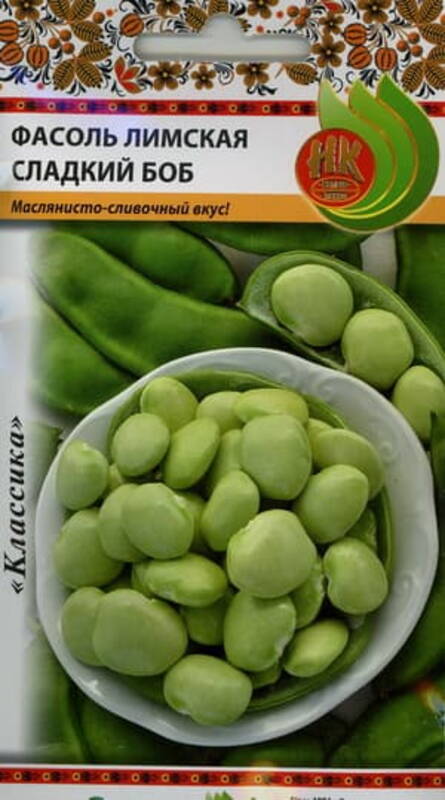
LIMA BEAN "SLADKY BOB" (Phaseolus lunatus).
Buttery-creamy taste!
Lima bean is a valuable dietary product: its seeds are an excellent source of vegetable protein (up to 25%).
Wide pods, 10-12 cm long, contain 3-4 large seeds, which are eaten boiled and fried. Also suitable for freezing and canning. Young seeds in the milky-waxy stage of ripeness have an amazing buttery-creamy taste, quickly saturate and prolong the feeling of fullness. Ready for consumption 75-90 days after germination. The crop is harvested as it ripens. The plants are climbing and require support.
Agrotechnics.
The most heat-loving of all types of beans. Sowing for seedlings or permanent place, when the soil warms up to at least +15°С. Seeding depth - 4-5 cm. Seedlings appear in 10-12 days. Planting in the ground when the threat of return frosts has passed. Placed on well-warmed, water-permeable, sandy loam soils. The optimum temperature for plant growth and development is +25°С. Care consists of timely watering, weeding and loosening the soil.
Buttery-creamy taste!
Lima bean is a valuable dietary product: its seeds are an excellent source of vegetable protein (up to 25%).
Wide pods, 10-12 cm long, contain 3-4 large seeds, which are eaten boiled and fried. Also suitable for freezing and canning. Young seeds in the milky-waxy stage of ripeness have an amazing buttery-creamy taste, quickly saturate and prolong the feeling of fullness. Ready for consumption 75-90 days after germination. The crop is harvested as it ripens. The plants are climbing and require support.
Agrotechnics.
The most heat-loving of all types of beans. Sowing for seedlings or permanent place, when the soil warms up to at least +15°С. Seeding depth - 4-5 cm. Seedlings appear in 10-12 days. Planting in the ground when the threat of return frosts has passed. Placed on well-warmed, water-permeable, sandy loam soils. The optimum temperature for plant growth and development is +25°С. Care consists of timely watering, weeding and loosening the soil.
* Peruvian lima bean has a bright green color, thin skin and dense pulp underneath. It can be eaten raw or cooked like regular dried (dried lima bean is white), but it is worth remembering that half a kilo of lima bean is comparable in nutritional properties to a kilogram of meat.
* Climbing varieties of lima beans can be sown in the usual wide-row method with row spacing of 60-70 cm and a distance of 10 cm in the row. Also, in individual areas, it is possible to recommend sowing in a square-nested method with row spacing of 50x60. Usually 3-4 plants are left in the nest.
Climbing lima beans can also be grown by seedling method. For this, seeds are sown in greenhouses 3-4 weeks before planting seedlings. Seedlings are planted in the phase of two true leaves at the same time as tomatoes, at a distance of 30x25 cm.
Beans do not tolerate transplanting well, so seedlings should be planted with a large clod of earth, and it is even better to grow them in peat-humus pots.
Care for crops in general does not differ from the care of bush varieties, but climbing varieties require the installation of supports. Stakes are placed next to the plants of climbing varieties at the rate of 1 support per 2-4 plants.
Since climbing lima bean gains a large vegetative mass, it requires more frequent and abundant watering compared to bush varieties.
Climbing lima bean is more productive than bush bean: the period of vegetation and harvesting is longer, because it has unlimited growth and can bloom and bear fruit until frost.
In climbing and semi-climbing varieties, the number of harvests of green pods is significantly increased compared to bush varieties (up to 15-20).
For growing in a backyard plot, the climbing lima bean variety "Sladky Bob" is ideal. This variety has wide pods up to 10 cm long, containing 3-5 large seeds. Matures in 65-75 days. Heat-resistant, resistant to adverse conditions, successfully grown not only in the south, but also in the middle lane. Young pods and ripe seeds are used for food in boiled or fried form; ideal for freezing.
Bot. syn.: Phaseolus bipunctatus Jacq., Phaseolus falcatus Benth. ex Hemsl., nom. nud., Phaseolus inamoenus L., Phaseolus limensis Macfad., Phaseolus macrocarpus Moench, Phaseolus portoricensis Bertero ex Sprengel, Phaseolus puberulus Kunth, Phaseolus rosei Piper, Phaseolus tunkinensis Lour., Phaseolus viridis Piper, Phaseolus xuarezii Zuccagni.